



Thousands of attendees stare at the LED wall. The shot they see was chosen, in a fraction of a second, by a single person sitting at a vision mixing desk. That person is the vision mixer, and at a major conference, vision-mixer event production is one of the most exposed jobs in the room. If anything is wrong with the shot, the audience sees it immediately.
Alexander Kurreck is a German broadcast technician and vision mixer working with Jakobs Medien. At the COP, the UN Climate Change Conference, he sat at the mixing desk while director Christoph called the show. He used iveo as a live show-flow tool for the first time at full scale.
In this interview, he explains:
- Why every outdated piece of information shows up instantly at the vision mixing desk
- How a real-time show flow cut his event prep from 20 minutes to 5
- What “time compression” really means for a stretched live production team
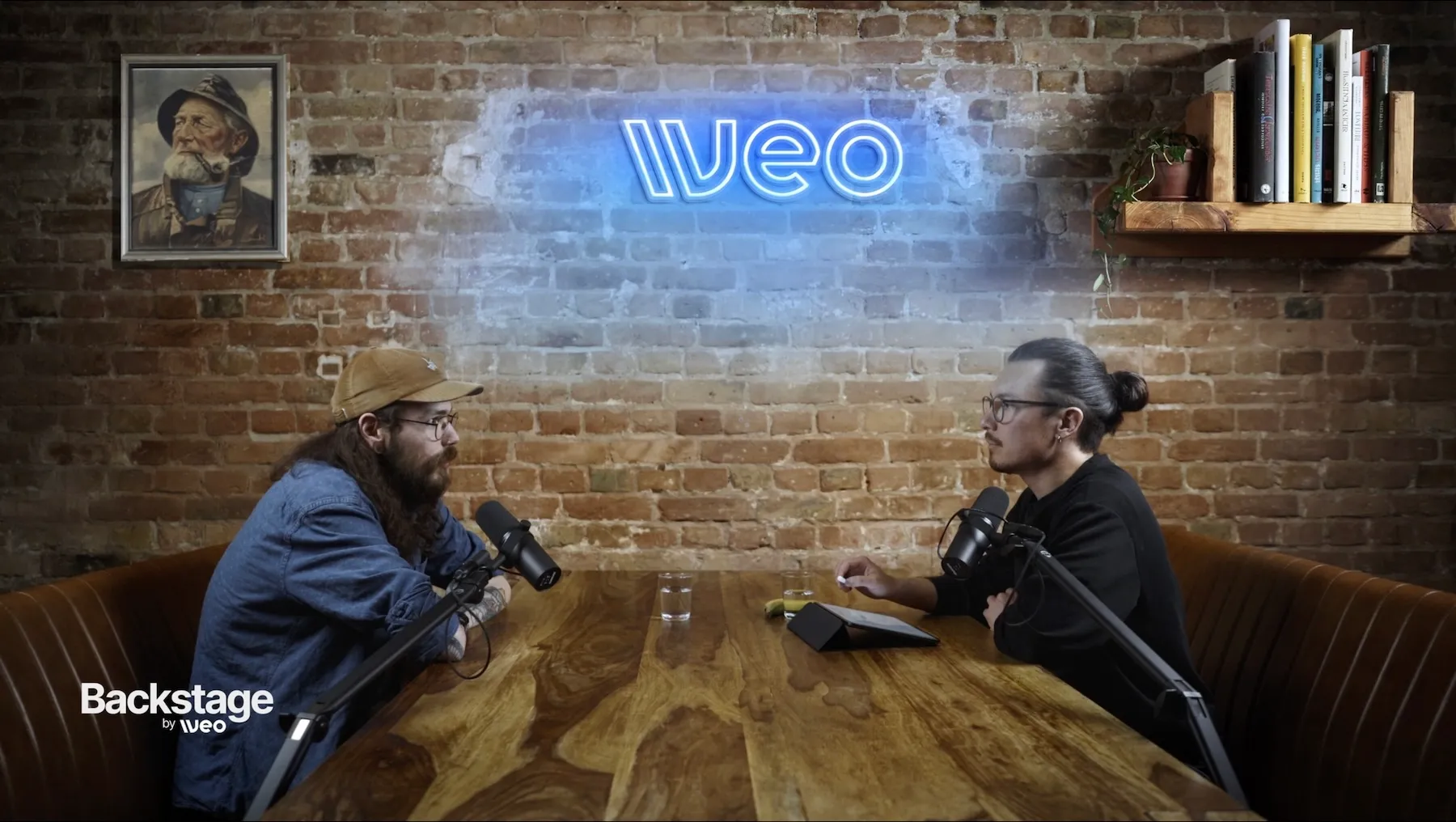
This is the second episode of our format Backstage by iveo. In Part 1, director Christoph Borstel explained how iveo brings every department onto one shared show flow: Read the Christoph interview.
What does a vision mixer actually do at a conference like COP?
If Alex has to explain his job in a single sentence, it sounds like this: “I’m the one who delivers the on-air picture. I have multiple sources, like cameras, presentations and logos, and I mix them together so that what the audience sees is a finished, branded shot.”
In broadcast, that role is sometimes called vision mixer (UK) or technical director / TD (US). What makes vision-mixer event production special is the immediacy: while the director keeps the overall picture and coordinates every department, the vision mixer is the place where decisions become reality on screen. At a conference like COP, that means several parallel camera feeds, picture-in-picture for remote speakers, lower thirds, logos, background graphics. All in real time.
Alex started his apprenticeship in the German media industry in 2018 and finished in 2020. He moved deliberately into live work. “Classic TV sets aren’t my thing,” he says. “I prefer live. Live doesn’t forgive.”
He describes his collaboration with the director as a tandem. Christoph signals what’s coming next; Alex puts it on screen. When the information arrives in time, nobody notices. When it doesn’t, everybody does.
“When the info arrives too late, everyone sees it. Live, on screen.”
Before iveo was used on his productions, prep looked like a typical live setup: “You collect the material, and you get a lot of different material. You bundle it. The project lead does that most of the time, but sometimes I have to.”
The real problem isn’t prep, though. It’s the seconds before a session starts. Speakers get swapped. Running orders shift. Decks get replaced last minute. When those changes don’t reach the desk, the consequence is brutally visible. Alex sums it up with one image:
“There is nothing worse than the speaker stepping up to the lectern and saying: That’s not my latest deck.”
That’s the vision-mixing nightmare in its purest form. Unlike the director’s chair, the mixing desk has no buffer. What Alex selects goes out, to every stream, every LED wall, every translation feed.
At a conference like COP, the pressure compounds: multiple sessions per day, fast turnarounds, international speakers, parallel programme strands. “On repetitive tasks, you make mistakes precisely because they’re repetitive,” Alex says. “You copy and paste, you stop double-checking, and at some point you don’t notice whether you actually pasted the right thing.”
That’s exactly the point where iveo comes in.
iveo on the monitor next to the mixing desk
“At COP we had iveo properly implemented for the first time. It runs on at least one screen at the desk, usually two. One of them is just so I can see what’s going on. And it follows whatever Christoph is clicking through on his machine.”
That is the moment a piece of software becomes a vision-mixing tool: a dedicated monitor next to the mixing desk, with the show flow updating in real time. Alex sees the day’s running order. The current item is highlighted. Press conferences, panels, side events. All on one canvas.
The decisive moment comes when a speaker is set live:
“When I see the line is set to ‘live’, I know the graphics are current. I know the lower thirds are right. And I know the deck is the right deck.”
In the past, Alex had to dig the right lower third out of fifty pre-built variants, maintain his own backgrounds, and re-export anything as soon as something changed. “Today we don’t do that any more. The moment Christoph sets the next item live, it pushes out to the channels. I pull it into my mixer and I can put it on screen with a clear conscience, because I know it’s the latest version.”
The same thing happens for last-minute people swaps: “When a person is selected, the lower third is generated automatically. I see the lower third has updated, and I just put it on air.”
Even the COP “Pink Day”, a daily theme that required adjusted branding on lobby screens at short notice, wasn’t a problem. “That’s the great thing. I just keep the same slot, I don’t touch the graphic at all. It’s changed in the background. I just take the output.”
More about the real-time show flow on our features page.
Same COP, two perspectives: Christoph at the director’s desk, Alex at the mixer
In Part 1 of this series, Christoph described the old reality: twelve Excel versions in circulation, no one sure which one was current. Alex confirms it from the vision-mixing side: “We used to spend a lot of time talking before the event. Showing each other content. Asking: Is this the right deck? Is that the right one?”
iveo changes that conversation:
“iveo compresses time. It’s like what people say about AI: time compression. I’m compressing the time I need to prepare for an event. From twenty minutes down to five.”
That sounds like an efficiency gain, but in live production, time you don’t spend re-checking is time you can spend on the show. Alex put it bluntly: “I don’t have to do anything. We had to talk less.” Instead of showing each other every file, he glances at iveo: presentation announced, file is in, done. Move on.
The post-event chaos disappears too: “After a show, you have everything locally on the machine. Three folders full of show flows, content, videos. With iveo the client just uploads it themselves. I download what I need and replace it. Less mess at the end.”
For freelancers and agencies running rotating live teams, that is the real benefit: a single source of truth that means less radio traffic, less duplicated communication, and less last-minute panic on site. We’ve collected what iveo means for technicians and agencies on the matching solutions pages.
“I now know in advance what’s coming, not when it’s already too late.”
When Alex sums up the change in one sentence, it lands as a small relief that anyone in live production will recognise:
“Less stress, more certainty. More calm, more certainty. That’s my takeaway.”
He sees the impact beyond his own role: “Everyone is on the same page. Information is distributed live. Everything updates by itself. I think the director ends up with less work too. You can focus on your job.”
For Alex, a self-confessed automation fan, that’s the punchline. Not less control. Less friction.
Key takeaways
- At the vision mixing desk, every outdated piece of information is immediately visible. There is no buffer between the desk and the LED wall.
- A real-time show flow replaces the nervous pre-show conversation. One glance at the monitor next to the desk confirms that the lower third, the deck and the speaker are all current.
- Saving prep time isn’t the point. It frees a stretched live team to focus on the show, not the spreadsheet.
Watch the full interview in the second episode of Backstage by iveo. More on the UN Climate Change Conference (COP) over at the UN.
Want to see how iveo can change your vision mixing? Get in touch.